
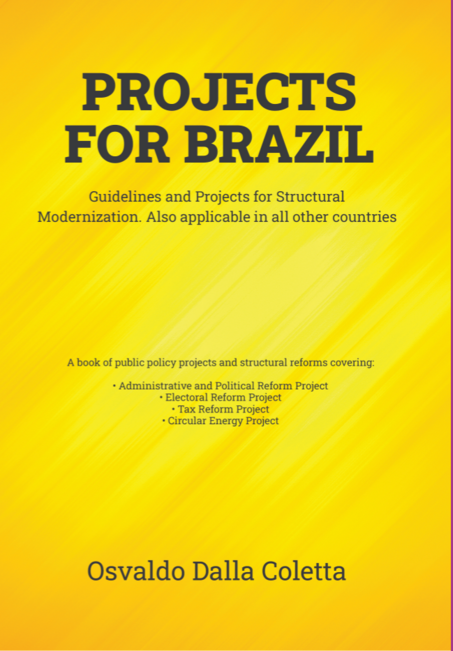
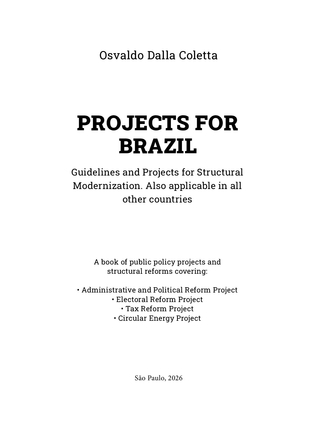
Establishment of a republican parliamentary system with a pure district voting system, five-year terms, and a ban on reelection for consecutive terms. The republican parliamentary system is an administrative and political system of representative democracy exercised by a government whose authority derives from the consent of the people, in which citizens elect representatives to act on their behalf in political matters.
The right to vote, to replace the current duty to vote.
A five-year term for all elected offices, with a ban on reelection for consecutive terms.
Acceptance of independent candidates with or without political party affiliation for the public offices of federal deputies, senators, state deputies, and city council members.
Prohibition of public financing and prohibition of financing from legal entities for political parties and election campaigns. Permission for financing from individuals for political parties and election campaigns up to a maximum limit of ten minimum wages per individual (per CPF).
Taxes: In the current Brazilian tax system, taxes consist of taxes, fees, and contributions. Currently (August 2026), there are 95 (ninety-five) consumption-based taxes in Brazil.
Single Tax (ST): This is the progressive income tax to be created to replace all 95 current Brazilian taxes.
Circular energy means reusing (recycling) the amount of energy used, minus the amount of energy dissipated in the process of transforming energy from one form to another.
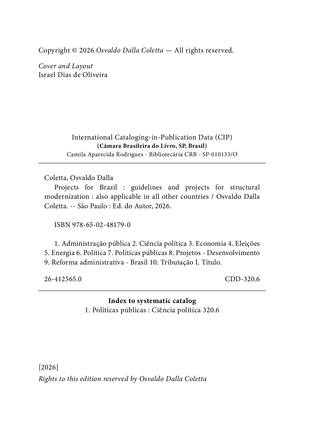
| ISBN | 9786502481790 |
| Número de páginas | 96 |
| Edição | 1 (2026) |
| Formato | Pocket (105x148) |
| Acabamento | Brochura s/ orelha |
| Coloração | Preto e branco |
| Tipo de papel | Offset 75g |
| Idioma | Inglês |
Tem algo a reclamar sobre este livro? Envie um email para atendimento@clubedeautores.com.br


Faça o login deixe o seu comentário sobre o livro.